How to Reduce Downtime in Manufacturing: How Custom-Engineered Conveyors and Rolls Cut Stoppages
For food, pet food, and consumer goods manufacturers, unplanned downtime in manufacturing is one of the most damaging problems a production line can face. A single stoppage can disrupt schedules, miss shipments, and push spare parts costs through the roof – and when downtime becomes a pattern rather, financial implications can multiply.
Maintenance teams and engineers know the causes well enough – whether it’s aging equipment, parts that arrive too late, or sub-optimal line layouts that fight against the process they’re supposed to support. What’s harder to fix is the source: production lines built around standard conveyors and machinery that were never designed for the specific demands of a given plant. That’s where custom-engineered solutions change the picture.
This blog explains how custom-engineered conveyors, supported by precision-built machinery, help manufacturers reduce downtime in manufacturing and keep lines running the way they were meant to.
Unplanned Downtime in Manufacturing: What it Costs
Downtime hits manufacturers in more places than the obvious lost production hours. Maintenance teams end up chasing emergency repairs and absorbing the cost of sourcing spare or one-off parts at short notice, which in turn forces engineers into budget conversations they hadn’t planned for. Once delivery schedules start slipping, the impact reaches operations managers contending with missed contractual commitments and the longer-term knock-on effect on customer relationships.
The bigger issue is that most downtime is a consequence of a production line that’s been forced to adapt to off-the-shelf equipment, rather than equipment that’s been engineered around the line.
Standard conveyors and machinery offer a baseline level of performance – but in regulated, high-throughput sectors like food and pet food processing, that baseline performance doesn’t hold up. Why? Because generic equipment is pushed beyond what it was designed for by common demands like regular washdown, multiple format changeovers across different SKUs, and hygiene compliance demands.
Why Off-the-Shelf Conveyors Create Downtime
Honestly speaking, off-the-shelf isn’t in F.N. Smith’s vocabulary. It’s not that we’re saying they don’t do the job, because they do, it’s just worth knowing that generic conveyors are built to serve a wide market. So what does this mean? It means they may not precisely fit a production line. There can be workarounds, but a non-custom approach can cause compromises such as:
- Hygiene constraints
- Layout limits
- Integration with upstream and downstream equipment
As a result, throughput targets and ROI suffer if any of these compromises occur – and the inefficiencies stack up over time.
Each one raises the probability of an unplanned stoppage, until the off-the-shelf equipment itself becomes the source of the downtime it was supposed to avoid.
How Custom-Engineered Conveyors Reduce Downtime
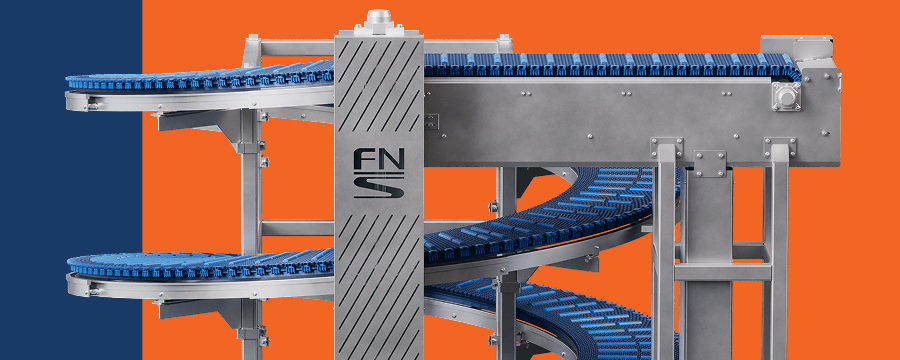
Custom-engineered conveyors solve the problem at its root. F.N. Smith designs and builds conveyor systems specifically for each customer’s process, product, and production goals – engineered right from concept to installation. With 30 years of production machine design behind every build, the result is machinery that integrates cleanly into the existing line, reducing the bottlenecks and integration challenges that drive stoppages.
The downtime benefits show up in multiple ways:
Faster Changeovers
Off-the-shelf conveyors are built to handle a wide range of formats, which means they handle none of them particularly well.
Custom-engineered conveyors are designed around the formats a manufacturer actually runs, with change parts and adjustments that take minutes rather than hours. The time saved on every changeover adds up across a shift, freeing production hours that standard equipment quietly loses to setup.
Easier Maintenance Access
A conveyor that’s hard to clean, hard to reach, or hard to service is a conveyor that builds downtime into the production schedule.
F.N. Smith engineers maintenance access into every build, with layouts that let engineers work quickly when components need attention. For older lines where original drawings have disappeared, reverse engineering keeps spare parts available and lines running well beyond the lifespan generic equipment would offer.
Shorter Lead Times for Repair Parts
Slow repair parts are one of the most common causes of extended downtime, especially when machinery was sourced off-the-shelf and original specifications are unclear. Working with the team that originally built the conveyor changes the equation.
Documentation is clearer, sourcing is faster, and there are fewer surprises when something needs replacing – because the build is already understood at the engineering level.
Hygienic, Regulation-Ready Design
For food and pet food manufacturers, hygiene complexity is a major source of unplanned stoppages. Stainless steel construction, clean-in-place (CIP) systems, and positive drive technology are built into F.N. Smith’s custom conveyor designs to handle cleaning cycles without slowing production. Each design accounts for the specific regulatory environment the conveyor will operate in, so compliance is built into the equipment rather than worked around it.
The Role of Conveyor Design in Keeping Production Running
The specifics matter. F.N. Smith’s custom conveyor solutions can include modular and cantilever designs that improve cleanability, food-grade construction for safe handling of meat, dairy, bakery, and beverage products, and HMI-controlled functions that simplify operator interaction. Robotic integration and bolt-on secondary designs allow conveyors to evolve as production needs change, rather than becoming the bottleneck that forces a costly line refit.
These aren’t surface-level features. They’re the result of one-on-one engineering between F.N. Smith’s team and the customer, which means every conveyor leaves the workshop fit for the exact production environment it’s heading into.
Custom Rolls and the Wider Production Line
Conveyors are only part of the story. For manufacturers running roll-based processes – particularly in food production – precision-engineered rolls play an equally important role in uptime. Components like flaking, shredding, and hex cutter assemblies are engineered for long life between regrinds, supporting high-volume production without the maintenance overhead that drags lines down. Together with conveyors, these custom-built systems form a production environment designed to keep running.
We Get The F.N. Job Done
Off-the-shelf machines perform. F.N. Smith machines outperform.
Custom-engineered conveyors, built by a team trusted by leading manufacturers when precision, reliability, and performance matter most, are designed to keep your line running – with no compromises and no shortcuts.
If unplanned downtime is holding your production back, F.N. Smith can engineer the solution.
Explore the conveyor solutions page to see how custom-built conveyors get the F.N. job done.